


Overall ratings summary:
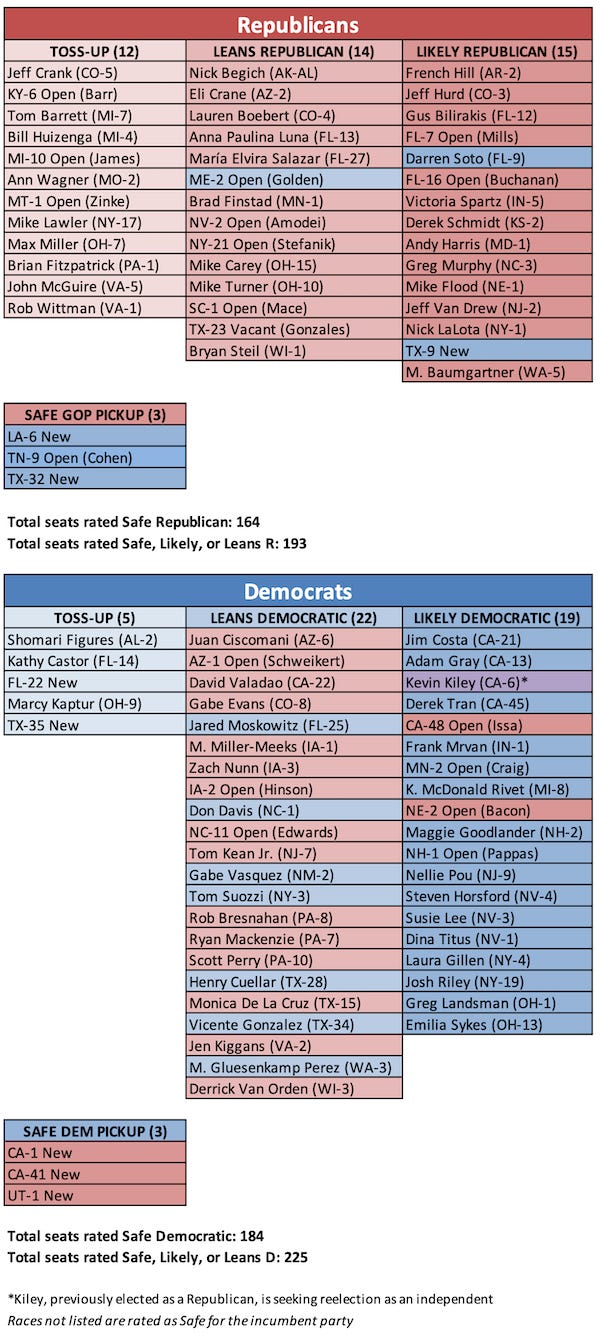
HOUSE: 225 at least Leans D, 193 at least Leans R, 17 Toss-ups. See ratings.
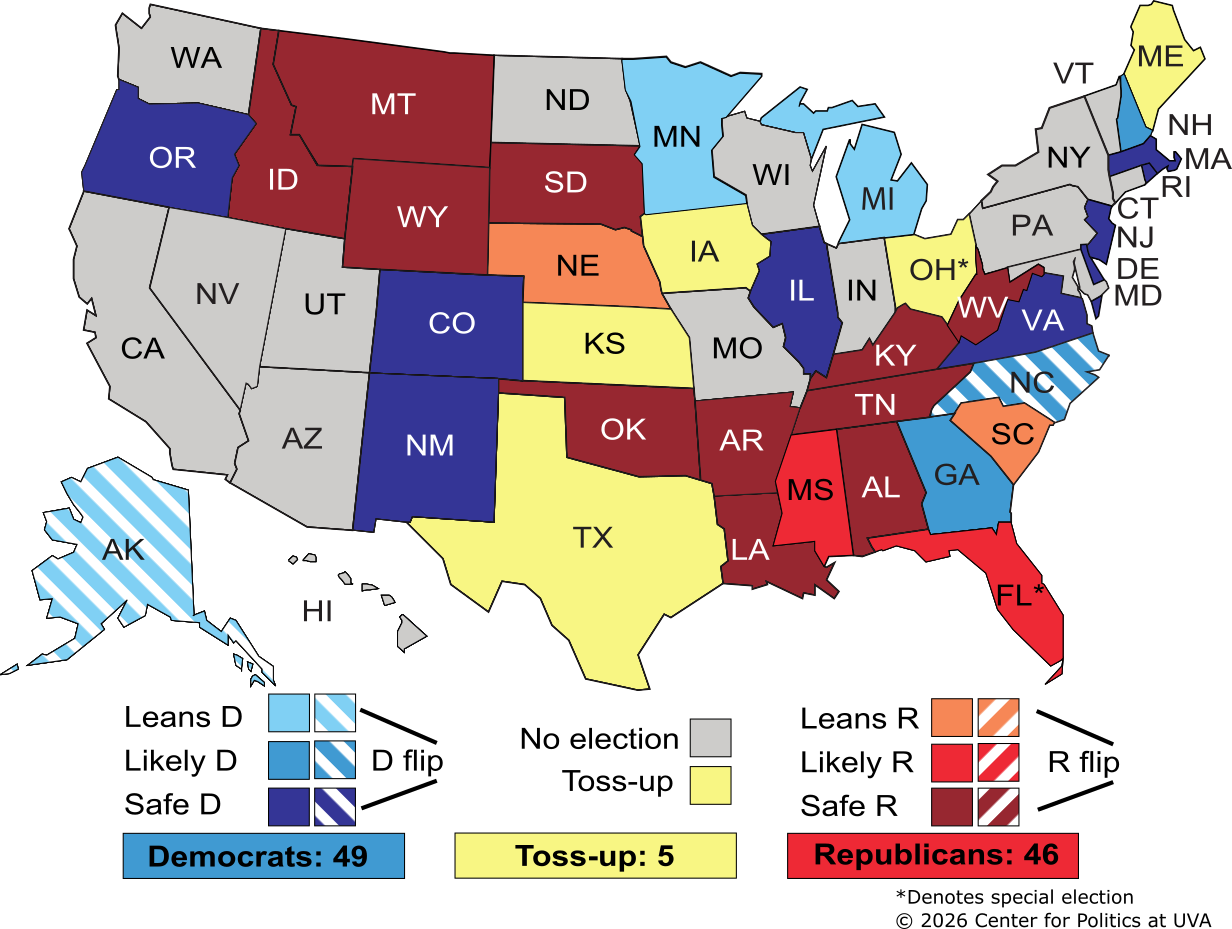
SENATE: 49 at least Leans D, 46 at least Leans R, 5 Toss-ups. See ratings.
GOVERNORS: 26 at least Leans D, 22 at least Leans R, 2 Toss-ups. See ratings.
KEY POINTS FROM THIS ARTICLE
— With a week until Election Day, Democrats seem to have a slight advantage in the battle for the Senate, with Maine and Texas emerging as the likeliest majority-making contests.
— In the Carolinas, we are making former Gov. Roy Cooper (D-NC) more of a favorite to win his state’s open-seat Senate race while making Sen. Darline Graham (R-SC) less of one. Sen. Ashley Moody (R-FL) also moves on to the board as Likely Republican, but she is still clearly favored.
— We are also upgrading Gov. Katie Hobb’s (D-AZ) standing while updating our ratings to show that Gov. Phil Scott (R-VT) appears to be in a close race.
— In the House, we are adding PA-8 and TX-15, two currently GOP-held seats, into the Leans Democratic column while pushing several other Republican-held seats into the Toss-up category.
Table 1: Crystal Ball Senate rating changes

Table 2: Crystal Ball gubernatorial rating changes

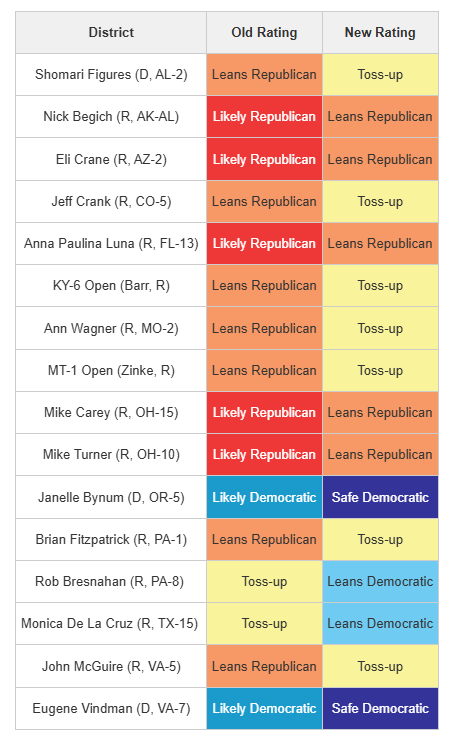
Table 3: Crystal Ball House rating changes
Map 1: Crystal Ball Senate ratings
Map 2: Crystal Ball gubernatorial ratings
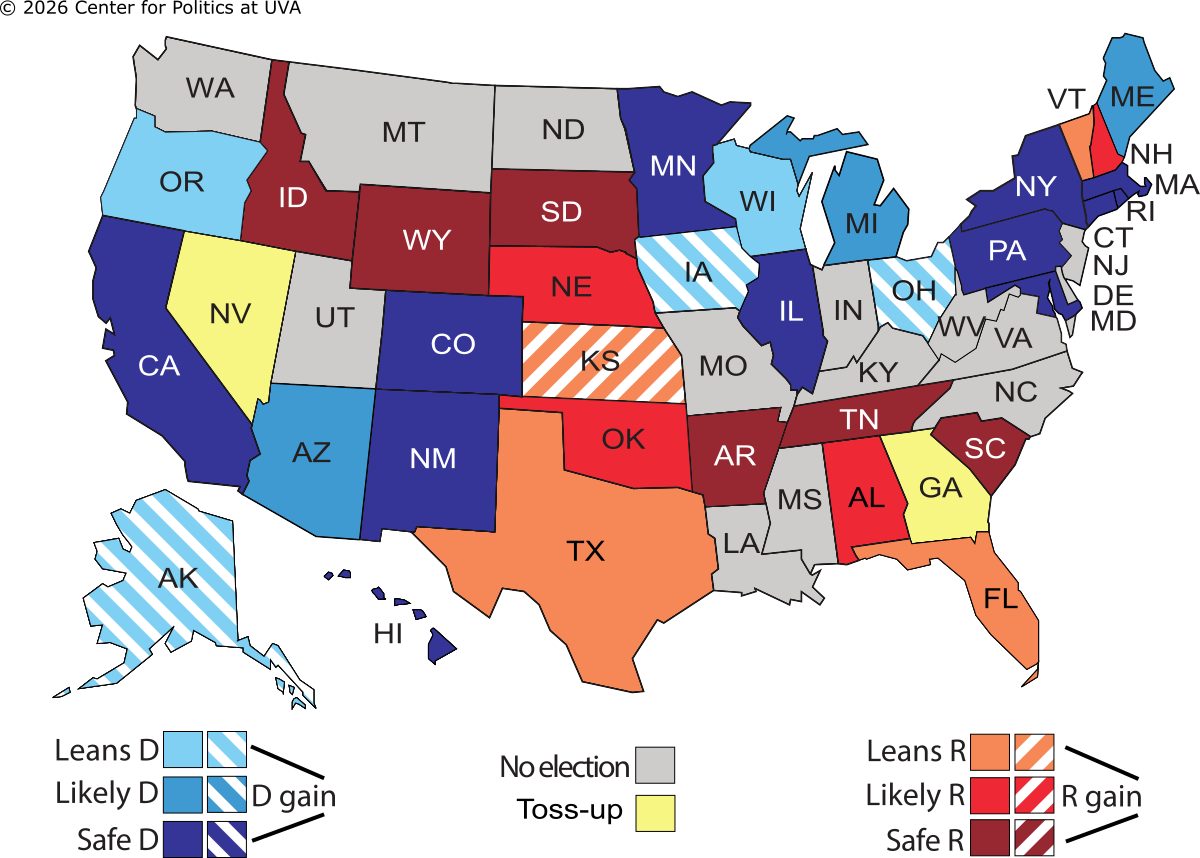
Table 4: Crystal Ball House ratings
How the Senate stands one week out—and more rating changes
Throughout the 2024 election, there was an incessant focus on seven key swing states that would determine the presidency. That group, comprising Michigan, Pennsylvania, and Wisconsin in the Industrial North, Georgia and North Carolina in the southeast, and Arizona and Nevada out west, all ended up breaking for Donald Trump.
With just a week to go until the 2026 midterm, the highly competitive race for the Senate again features seven key states, although only one of them—Michigan—is on both the 2024 and 2026 lists. That also is the only one of the seven that Democrats are defending; the others are Republican defensive assignments in Maine, otherwise a blue state, as well as red states Alaska, Iowa, Kansas, Ohio, and Texas. Just as in 2024, the polling in all seven of these races is fairly tight, with the largest lead being a little under 4 points in the Silver Bulletin’s averages (that is Democrat Mary Peltola’s current edge in Alaska, which is not polled very much compared to some others). But Democrats do technically lead in all of these state averages as of this writing, even if the leads are often quite marginal.
These are not the only competitive seats, but they are the ones where we wouldn’t at this point consider a win by one side or the other as very surprising. Still—seven is a lot of states, and that doesn’t even include some other states that are competitive but where the underdog winning would be a bigger surprise, like Minnesota, Nebraska, and South Carolina. Assuming no other upsets, the side that wins a majority of these seven states would win the Senate: four of seven would get Democrats to 51 seats or Republicans to 50, a quasi-majority with the vice presidential tiebreaker.
We have had Alaska and Michigan at least leaning to Democrats for the past several weeks, and we still feel OK about those ratings; both the aforementioned Peltola and former Wayne County Health official Abdul El-Sayed (D) have usually posted narrow but consistent leads in polls. In electorally marginal Michigan, the pro-Democratic environment is papering over some of El-Sayed’s weaknesses, and he still appears to be lagging Secretary of State Jocelyn Benson (D) in the gubernatorial race: While it represents something of an extreme example, a fresh YouGov/Michigan State University poll showed the former running about 10 points behind the latter. A WDIV/Detroit News Glengariff poll released Tuesday, on the other hand, had El-Sayed up 6 and Benson up 7, almost identical. Meanwhile, Peltola benefits from a unique election system. Setting its (dubious) legal merits aside, the Trump administration’s recent announcement that it was suing to block certification of the election if Peltola won also does not exactly telegraph confidence in the GOP’s chances.
While the others are Toss-ups and remain so today, we have an inkling of where we’ll lean them before the election. It is not all that different from what we wrote right before Labor Day, but the Democratic position has improved over the course of the fall.
We have already leaned Ohio’s governor race to Democrats, and that’s probably where we’ll end up in the Senate race barring clear evidence to the contrary. On the flip side, we ultimately struggle with the idea of a Democrat winning a Senate race in Kansas, as good of a campaign as Adam Hamilton (D) has run and as poor of one as Sen. Roger Marshall (R-KS) has run. Most seem to agree that the top GOP candidate in any of these seven states aside from Sen. Susan Collins (R-ME) is Rep. Ashley Hinson (R-IA). Hinson’s relatively strong campaign, plus Iowa’s generic lean, could very well be enough to save her in the Hawkeye State even if state Auditor Rob Sand (D), as we and others expect, wins the governorship. So Republicans may get the leans designation in Iowa and Kansas.
Maine and Texas, to us, are the hardest races to gauge—and, challengingly, they represent the majority-making seats if things play out as described above. At this point we do think Democrats will get at least one and possibly two of these seats. We know that Collins is an electoral force, but the weight of this horrible environment for Republicans may just be too much to overcome.
Meanwhile, in Texas, going just by polls and candidate quality, the case for picking state Rep. James Talarico (D) might be comparatively straightforward. But, of all the states we have discussed so far, a Democratic win in Texas might have the most “I’ll believe it when I see it” factor, given the party’s more than 3-decade drought there. Still, the early vote does not seem especially promising for Republicans so far.
Per Crystal Ball tradition, we will boldly, or sheepishly, push all the Toss-ups to Leans before the election. But as of this point, we are thinking the Democrats have the inside track to a Senate majority, albeit narrowly at 51 or 52 seats. But these races are all close, and we want to take in all of the final information before pushing the remaining Toss-ups.
This week’s rating changes
Beyond our overall Senate assessment, we have several rating changes this week.
— In the House, we are continuing to push races toward Democrats. That includes moving two Toss-ups to Leans Democratic. In northeast Pennsylvania’s PA-8, Scranton Mayor Paige Cognetti (D) has led Rep. Rob Bresnahan (R) by 5 and 4 points, respectively, in a pair of recent nonpartisan surveys, one from the Philadelphia Inquirer/New York Times/Siena University and the other from Emerson College for Sean Trende’s new Poll Vault Substack. Meanwhile, in TX-15, singer Bobby Pulido (D) led Rep. Monica De La Cruz (R) by a 51%-44% margin in a Barbara Jordan Public Policy Research and Survey Center poll conducted for the San Antonio Express-News; this mirrors previously-released Democratic polling. Democrats appear headed for a big rebound in South Texas.
— Our line on the House recently has been that Democrats are in good shape to get into the 230s. But could they actually exceed the 235 seats they won in 2018? Maybe, as unexpected races flow onto the competitive board. CNN’s Sarah Ferris and David Wright had a detailed report about this Republican vulnerability late last week. To reflect the possibility of a Democratic megawave that pushes the party past 235 seats, we are moving several seats from Leans Republican to Toss-up. We may end up pushing many if not all of these races back to Leans Republican in our final ratings, though. These are open GOP-held seats in KY-6 and MT-1 as well as Reps. Jeff Crank (R, CO-5), Ann Wagner (R, MO-2), Brian Fitzpatrick (R, PA-1), and John McGuire (R, VA-5). These are all generally red-leaning seats with the exception of Fitzpatrick in PA-1, who is in a Harris-won seat. The aforementioned Siena Pennsylvania polling had Fitzpatrick down 2 points, a surprising finding given his electoral resilience. We are also putting Rep. Shomari Figures (D, AL-2), who got a tougher district for 2026, into this category. Though Trump carried it by 14 points in 2024, then-Sen. Doug Jones (D) lost Figures’s redrawn Montgomery-area seat by just 4 points in 2020. In a bluer environment, it is possible to see Jones (who is now running for governor) and Figures putting together a winning coalition there.
— Reps. Nick Begich (R, AK-AL), Eli Crane (R, AZ-2), Anna Paulina Luna (R, FL-13), Mike Carey (R, OH-15), and Mike Turner (R, OH-10) all move from Likely Republican to Leans Republican—these are some of the seats that could be in play if Democrats have a huge night. The Alaska at-large race features an independent, Bill Hill, who will need to hold Begich under 50% in the first round of voting to trigger an RCV vote that he could hypothetically then win—there is also an actual Democrat among the candidates in the top four vote who will presumably take votes from Hill, at least initially.
— On the Democratic side, Reps. Janelle Bynum (D, OR-5) and Eugene Vindman (D, VA-7) won expensive races for light blue seats in 2024, but neither appears to be in any danger of losing this year. Both move from Likely Democratic to Safe Democratic.
— At the start of the cycle, it seemed like the reelection bid of Gov. Katie Hobbs (D-AZ) and the now-open North Carolina Senate race would be two of the hottest races in the country. But it has been apparent for some time that Democrats have a clear edge in these reddish purple states, so we are moving both from Leans Democratic to Likely Democratic. Our reasoning for both moves is similar to what our thinking was when we made the same change in the Georgia Senate race over the summer: While Democrats might not win these races in double-digit routs, it would be stunning at this point if either Hobbs or former Gov. Roy Cooper (D-NC) lost.
— In North Carolina, the scope of Cooper’s win could conceivably have down-ballot implications. Last week, we moved a couple of key North Carolina House races—the open NC-11 contest and Rep. Don Davis’s (D, NC-1) reelection effort—from Toss-up to Leans Democratic. If there is a Republican turnout collapse in the Tar Heel State, Republicans could get a little uncomfortable in other districts as well (the early vote has been weak for Republicans there so far). With the exception of the aforementioned NC-11, which is the least red, all 9 currently Republican-held seats in the state each gave Donald Trump between roughly 55% to 58% of the vote in 2024—in other words, as they sought to maximize the number of seats they could control, Republicans drew themselves a bunch of usually-safe, but perhaps not ironclad, seats. We previously flagged Rep. Greg Murphy (R, NC-3), whose district was made less Republican in a 2025 gerrymander in order to hurt Davis, as a Likely Republican race. Though we are holding his seat at Safe Republican, Rep. Richard Hudson (R, NC-9) may be the most prominent such case, as he is the National Republican Congressional Committee chairman. Hudson faces Richard Ojeda (D), a veteran and former West Virginia state legislator who ran a notable House race in the Mountain State in 2018, and Hudson has been getting a little help from the NRCC in his race.
— On the other side of the Carolina border, Sen. Darline Graham (R-SC) continues to be in what polling suggests is a very close race with physician Annie Andrews (D). A Targoz Research/South Carolina Policy Council poll released Tuesday morning showed Graham up just 47%-46% while Attorney General Alan Wilson (R) led the gubernatorial race by a more robust 51%-41% margin, indicating a weakness specific to Graham, who replaced her late brother in the Senate. The close Senate poll mirrors others, and the most Republican state on the Atlantic coast is seeing heavy spending down the stretch. We would ultimately be really surprised if Graham lost, as this is a state where we would expect a tied poll to ultimately break to the Republican, but Leans Republican better reflects the late competitiveness than Likely Republican.
— Speaking of Republicans potentially winning by uncomfortable margins, last month, we moved Gov. Phil Scott’s (R-VT) race from Safe Republican to Likely Republican. We are now moving the race into the even more competitive Leans Republican category. Scott, who has frequently been ranked as one of the nation’s most popular governors for much of the last decade, seems to be in a genuinely close race against economist Amanda Janoo (D). The Republican Governors Association recently put six figures into the contest to help Scott, and the tone of Scott’s campaign is noticeably more negative than usual. In what was perhaps a telling move, Sen. Bernie Sanders (I-VT), who usually sticks to making endorsements in federal races and has had a good working relationship with Scott, endorsed Janoo in early October. There might be an element of voter fatigue at play: A new State Navigate poll found that while Scott himself remains well-liked—58% approve of his performance as governor—he was only leading Janoo by a 49%-46% margin.
— Finally, Florida’s Senate race is moving from Safe Republican to Likely Republican. We rate the gubernatorial race as Leans Republican, and polling in the two contests has been similar enough that we thought it made sense to bring their ratings closer together. Republican Sen. Ashley Moody remains clearly favored, but Democrats have some reason for optimism: Matthew Isbell’s latest early voting analysis shows registered Democrats maintaining a roughly 8-point turnout advantage over registered Republicans, a substantially better position than they held at this point in 2024 (although Republicans, who have a 1.5-million registration advantage over Democrats, finally surpassed them in the overall advance vote Monday). Democrat Angie Nixon has also been a robust fundraiser, not unlike many other Democratic Senate candidates. We don’t expect the early voting numbers or the fundraising numbers to translate into a Democratic victory, but, together, they reinforce the case for a more competitive rating.