

Overall ratings summary:
HOUSE: 214 at least Leans D, 201 at least Leans R, 20 Toss-ups. See ratings.
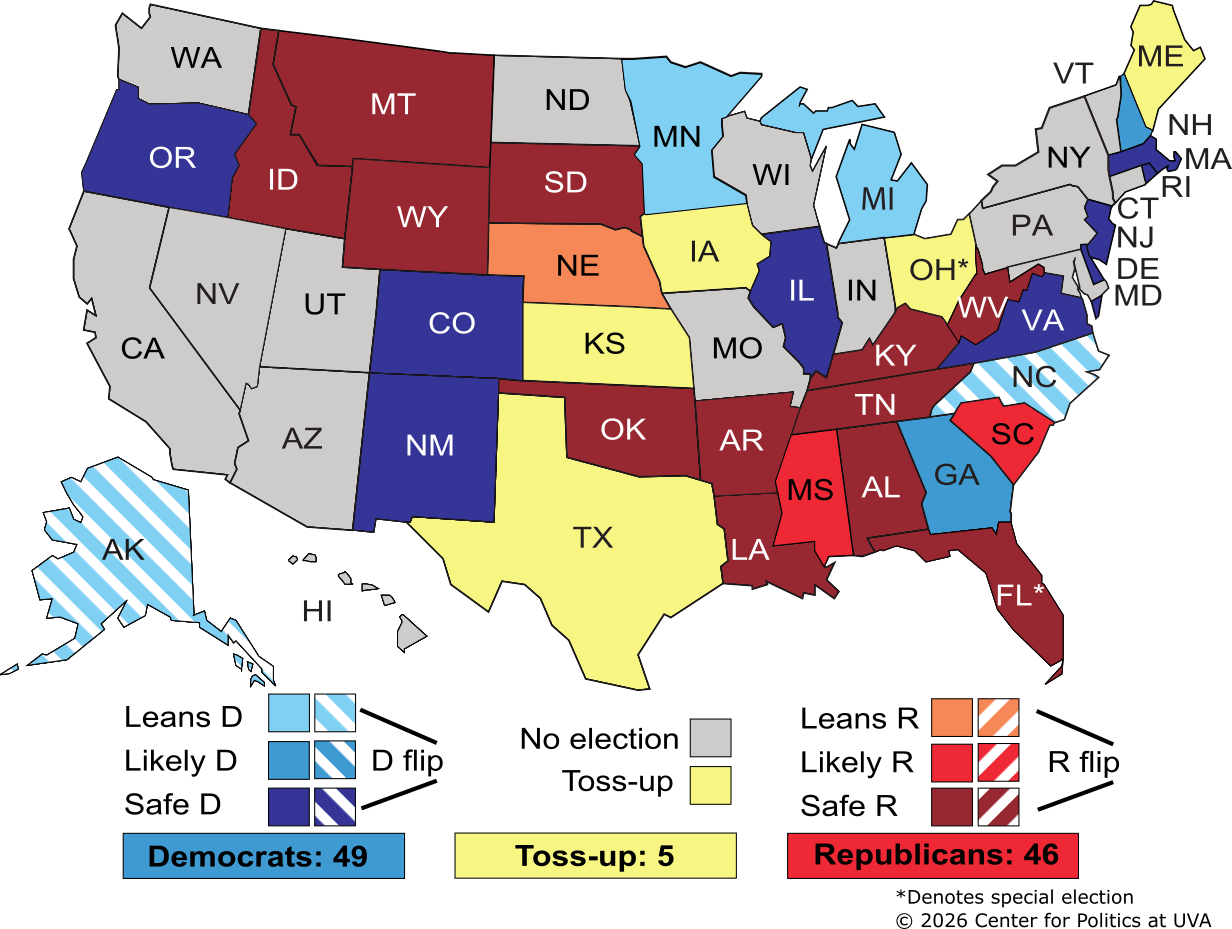
SENATE: 49 at least Leans D, 46 at least Leans R, 5 Toss-ups. See ratings.
GOVERNORS: 25 at least Leans D, 22 at least Leans R, 3 Toss-ups. See ratings.
KEY POINTS FROM THIS ARTICLE
— Rating changes this week leave us with five Senate Toss-ups, all in Republican-held seats.
— Republicans now need four of these five Toss-ups (Kansas, Iowa, Maine, Ohio, and Texas), although all of these save the Pine Tree State are naturally red states where it shouldn’t surprise anyone if Republicans hold on.
— Other changes involve races that are more on the periphery of the core battleground but merit watching for possible upsets or surprising trends.
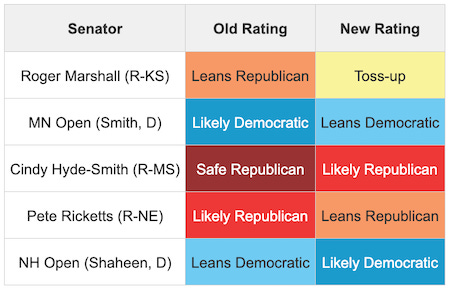
Table 1: Crystal Ball Senate rating changes
Map 1: Crystal Ball Senate ratings
We are now less than three weeks from the election. Broadly speaking, there are not really any clear signs of a Republican recovery. The basic structure of the Senate map does still give Republicans clear avenues to hang on to their majority even if their position as the Senate favorite has evaporated over the course of the cycle. The House, meanwhile, remains extremely likely to flip to Democrats.
If Republicans end up beating expectations, it would probably speak to some of the broader challenges facing the polling industry. We have heard (and read) that pollsters may be having a more difficult time than usual reaching certain subsets of Republican voters; this may be distorting expectations in red-leaning places where Republicans who are reluctant to answer polls might still vote. On the other hand, it may be that a difficulty in polling Republicans is just reflective of both GOP leakage with their own voters as well as reduced Republican turnout, which Republicans knew would be a challenge in the midterm regardless, let alone with a president whose net approval is more than double as bad as it was at the time of the 2018 midterm (Trump was at -9 net approval in the 2018 exit poll but is at least 20 points underwater now, according to averages of national polls). Last night at the Center for Politics, the Crystal Ball team discussed the midterms with Votebeat’s Nathaniel Rakich as well as pollster Natalie Jackson—her analysis of polling ended up being a major focus of the discussion, so check out the panel on YouTube if you’re curious about the state of the polls.
Early voting trends may help fill in the blanks, although such analysis requires not just a grain of salt, but a full spoonful (or maybe even a bucket). For instance, some have noted that Democratic vote by mail requests are down in certain places compared to 2022. On the surface, that seems good for Republicans, but we also are much further away from the pandemic (an event that pushed voters to consider options other than voting in-person). President Trump polarized Republicans against voting by mail because of his criticisms of the practice, and he may now be polarizing some Democrats against voting by mail as well because Democrats worry about their ballots being delivered, particularly after the president tried and failed to give the Post Office oversight over who votes by mail. Rakich, during last night’s panel, said he believes voting by mail should be fine this year, but he suggested that voters mail their ballots early to make sure they are delivered in time.
Another indicator of a sour environment for Republicans comes from money moves. We are now seeing instances of “triage,” when a party cuts money from a race they no longer believe they can win. More broadly, cutting ad reservations can signal either resignation or confidence: In the Georgia and North Carolina Senate races, Republicans pulling money out signals the former, while Democrats pulling money out signals the latter. Republicans also recently cut spending for a pair of House incumbents who we previously flagged as underdogs: Reps. Mariannette Miller-Meeks (R, IA-1) and Tom Kean Jr. (R, NJ-7). Speaking of money, third quarter fundraising reports released later this week will provide more of a window onto the competitive House playing field.
In the meantime, we have several moves to make in the upper chamber. Our roster of Senate Toss-ups grows this week, as Sen. Roger Marshall (R-KS) moves onto that list, while other moves involve the Leans and Likely columns. We noted last week that, for the first time all cycle, Republicans now needed to win more Toss-ups than Democrats did in order to win the Senate, and the Kansas move—a GOP-held state—now means Republicans need 4 of the 5 Toss-ups to hold the Senate, while Democrats still just need two. That said, it is also the case that 4 of the 5 Toss-ups are double-digit Trump states: Polling is basically tied in two of them (Iowa and Kansas), while Democrats have a small lead in averages in the other two (Ohio and Texas). If Republican turnout and performance is better than polls suggest, the natural redness of these states may still allow Republicans to hang on in many if not all of them, with Iowa and Kansas still probably likelier to stick with Republicans than Ohio and Texas. And then there is Maine, where Sen. Susan Collins (R-ME) should lose based on the environment and the recent fate of Senate incumbents in hostile states, and yet it’s not at all clear that she will. There is also Alaska and Michigan, where we give a small edge to Democrats but both races are obviously still quite competitive.
Let’s go through the five changes in today’s update:
Kansas (Leans Republican to Toss-up): We were hesitant to move Sen. Roger Marshall’s (R-KS) reelection bid to Toss-up, but a full-on Republican rescue operation appears underway for Marshall, which along with other developments prompts us to move it there for the time being. Senate Leadership Fund recently jumped into the race with an eight-figure investment, and a top GOP operative, Chris Grant, was just dispatched to aid Marshall, reminding us of when a different Chris—LaCivita, now a top political adviser to Trump—helped save Sen. Pat Roberts (R) in the 2014 cycle. Roberts had been caught flat-footed by independent Greg Orman, an early example of what has become a more common red state phenomenon (an independent running in lieu of a Democrat). Now, Marshall needs help against pastor Adam Hamilton (D), who considered running as an independent but is now either tied or even sometimes leading against this incumbent in public polling.
We are ultimately skeptical of a Democrat winning a Senate race in Kansas, and that may be reflected in our final rating here. But long winning streaks don’t have to continue in perpetuity. An important piece of the puzzle in Kansas is the presence of Libertarian David Graham on the ballot; Libertarians have routinely received several points worth of support in recent Kansas Senate races, which means that the eventual winner probably won’t need a majority to win.
Nebraska (Likely Republican to Leans Republican): One state north of Kansas, we have had Nebraska at the edge of the playing field ever since 2024 Senate candidate Dan Osborn (I) got into the race. In 2024, Osborn, who seemed to sneak up on then-Sen. Deb Fischer (R), came closer than any actual Democrats did that year to defeating an incumbent Republican senator. As part of Osborn’s relatively close 6.5-point loss, he performed especially well in the rural western 3rd District, losing it roughly 2-to-1 while Kamala Harris lost the seat more like 3-to-1. In his ads, Osborn seems to be showing a lighter, less rough-edged version of himself than the one we saw lighting television sets on fire two years ago—perhaps this could be read as an attempt at winning over suburban voters in the Omaha area, a group with whom he ran relatively closely with Harris in 2024.
In 2024, then-appointed Sen. Pete Ricketts (R) was also up for, and easily won, a partial term. Now running for a full 6-year term, Ricketts faces Osborn. Though Ricketts can self-fund and comes from a billionaire family, he has recently gotten some outside help from a couple of notable sources: the pro-crypto Super PAC Fairshake and the aforementioned SLF have spent or will spend a combined more than $20 million boosting him, the Wall Street Journal recently reported. An early October poll from National Public Affairs, a Trump-aligned firm, showed Ricketts leading by 3 points. That tracks with other GOP-aligned polls, while some other Democratic as well as occasionally nonpartisan polling has shown something more like a tie.
It could well be that Osborn, while he put up a respectable showing, ultimately missed his best shot, which was in 2024. Punchbowl News also recently noted that Osborn’s campaign has seen turnover in some key staff positions since the summer, and some leaked audio may be making Osborn seem more partisan. However, from what we can tell, he may not be that far behind Ricketts.
A small structural difference between this year’s Nebraska contest and 2024’s is the party lineup. In 2024, Fischer held on in a binary contest with Osborn. Next month’s matchup will feature a couple of other minor party candidates, although their presence has not seemed to impact the margins much in polling.
New Hampshire (Leans Democratic to Likely Democratic): Moving north, we are flipping ratings for Democrats in a pair of open-seat contests in light blue states that feature heralded GOP recruits. In the weeks since the Granite State’s early September primary, Rep. Chris Pappas (D, NH-1) has seemed to find his footing against former Sen. John Sununu (R-NH). In fact, Pappas has been at or exceeding 50% in recent nonpartisan polling. While New Hampshire does have a certain independent streak, its idiosyncrasies are most visible in state-level, not federal, politics. Since the aforementioned Sununu’s defeat in the 2008 wave to now-outgoing Sen. Jeanne Shaheen (D), New Hampshire, at least in Senate races, has performed about in line with how one might expect a light blue state to: aside from 2010, where the state reflected the national red wave, Democrats have won every Senate race. Despite a lot of national attention on this race, it would be a big surprise to us at this point if Pappas lost.
Minnesota (Likely Democratic to Leans Democratic): In most cases, Minnesota might be the textbook example of a “Likely Democratic” state, but progressive Lt. Gov. Peggy Flanagan’s (D) performance in polls has been underwhelming enough to warrant a closer look at this race. After a landslide primary win over a more moderate alternative, Flanagan is seeking to hold the seat being vacated by retiring Sen. Tina Smith (D), who endorsed her in advance of the primary, while Republican Michele Tafoya, a former sportscaster, is hoping to capitalize on voter frustration with the state’s Democratic leadership.
Flanagan has generally maintained narrow leads in public polling, but she has yet to establish the kind of consistent advantage Democrats would prefer in a state that has not elected a Republican to the Senate since 2002. Last week, a Mason-Dixon poll put Flanagan up 47%-43% on Tafoya—a result not far out of line from Smith’s 49%-44% from 2020, but still a margin that would seem somewhat out of place in a more pro-Democratic year.
The Tafoya campaign frequently points to controversy surrounding fraud in Minnesota’s social services programs, giving Republicans a concrete line of attack against the state’s Democratic administration. Flanagan’s proximity to outgoing Gov. Tim Walz (D) as voters weigh questions of accountability and oversight is a wild card in the race.
Democrats remain favorites to hold this seat—and the fact that the race has not drawn serious outside spending is telling even as money splashes all over the battlefield—but we have nonetheless felt underwhelmed by the numbers Flanagan has posted.
Mississippi (Safe Republican to Likely Republican): Finally, we are nudging Mississippi onto the periphery of the playing field. This move is essentially a nod to the possibility that Democratic gains this year could be especially felt in poorer, and redder, states, which could produce margins closer than one might otherwise expect. In next-door Arkansas, for instance, our eyebrows were raised last week when a poll from allies of Sen. Tom Cotton (R-AR) showed him up just 50%-39% in a state that is a couple notches redder than Mississippi. Sen. Cindy Hyde-Smith (R), who is up this year, has never seemed to be as popular as fellow Sen. Roger Wicker (R), the latter of whom found some notable crossover support in 2024. The Democratic nominee, Scott Colom, has implored national Democrats to invest more in the race, although it has already gotten some investment from the Democratic outside group American Bridge, and former President Barack Obama recently cut a video endorsing him. A certain “X-factor” at play here might be the fact that, as one of our contacts familiar with the state put it, because Mississippi lacks state-level races this year and has boring House races, the Senate race has a “special election” feel.

