


KEY POINTS FROM THIS ARTICLE
— Virginia Democrats finally unveiled a proposed partisan gerrymander on Thursday night that is intended to elect 10 Democrats and 1 Republican if implemented for 2026.
— If realized, that would be a 4-seat net gain for Democrats compared to the current delegation.
— However, the map would not be guaranteed to produce such an outcome, even if 2026 is a good year for Democrats. Specifically, the proposal maintains VA-2, held by Rep. Jen Kiggans (R), as one of the nation’s premier swing seats while also creating another competitive, though slightly Democratic-leaning, district covering a constellation of college towns in Central Virginia.
— Hurdles remain for this map to actually go into effect—Virginia voters would have to give the legislature the power to impose the map through a statewide vote scheduled for April 21. And there is also an ongoing legal fight that could effectively block the map.
The proposed Virginia map: 10-1 quite possible but not guaranteed
Right before the 2025 Virginia elections, the Democratic-controlled Virginia state legislature made a surprising entrance into this cycle’s redistricting wars. They began the process of asking voters to amend the Virginia constitution to allow them to set aside the state’s congressional map and replace it with a pro-Democratic map. Following the election and after the new General Assembly began their session at the start of 2026, Virginia Democrats held the required second vote to place a constitutional amendment before voters, setting a special statewide election for April 21.
On Thursday, Democrats finally released the map that they would impose if given that power by voters. It would be in effect for the 2026, 2028, and 2030 elections.
As we’ve done with map proposals in other states, what follows is how we think we would rate the map if it went into effect. To be clear, we are not changing any ratings now, as the map is not operative.
While we do think Democrats would be favored to win the statewide referendum that would allow them to override the current map and enact their own gerrymander—Democratic voters are more engaged right now and we just saw them turn out in force in last November’s gubernatorial election—they would not be guaranteed to win. Additionally, there is an ongoing legal dispute over whether Virginia Democrats followed the proper procedures for setting up this vote. A lower court judge, albeit from deeply Republican Tazewell County, already ruled against them, and an appeal is headed to the Supreme Court of Virginia. We are daring enough to predict elections, but not foolish enough to predict courts. So this is all up in the air.
First, let’s look at the map as it stands now. The current map is court-drawn after the state’s new bipartisan commission system, itself approved by voters as a legislatively-referred constitutional amendment, failed to produce a map following the 2020 census.
There are four super-safe Democratic districts (Districts 8 and 11 in Northern Virginia and 3 and 4 in Richmond/Hampton Roads); two super-safe Republican districts (Districts 6 and 9 in western Virginia); a couple of districts that frequently give Republicans only single-digit margins (District 5 in Central Virginia, which is relatively inelastic and does not seem like a real Democratic target even in the context of 2026, and District 1 on the Peninsula, which likely will be); a Democratic-leaning district that could be competitive under the right circumstances (District 10 based in Loudoun County); a more competitive but Democratic-leaning district (District 7 based in Prince William County); and a classic swing seat (District 2 based in Virginia Beach).
Map 1 shows the current districts and gives their partisan breakdowns in the 2021 gubernatorial and 2024 presidential elections. The former could be thought of as a stand-in for the GOP’s “high water” mark in the state, while the latter represents more of a standard result in the state. Kamala Harris carried 6 of the 11 districts—and came very close in another—while winning the state by about 6 points. Now-former Gov. Glenn Youngkin (R) also carried 6 districts while winning his election 51%-49%.
Map 1: Current Virginia districts with 2021 & 2024 data
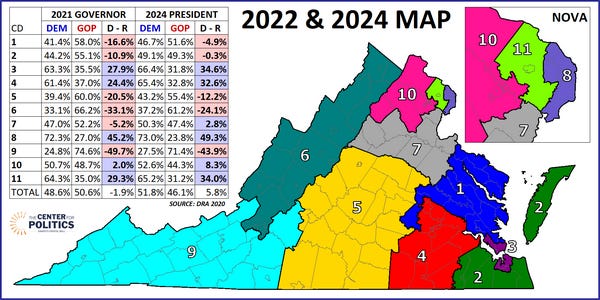
In both 2022 and 2024, the map elected a 6-5 Democratic House delegation, with both parties winning every seat that naturally leans their way and Rep. Jen Kiggans (R) winning competitive races in VA-2, which backed Joe Biden by 2 points in 2020 and Trump by a couple tenths of a point in 2024. The median seat based on presidential performance is VA-7, held by first-term Rep. Eugene Vindman (D). The district voted for Biden by about 7 points and for Harris by 3 points, making it a few points bluer than the nation as a whole but a few points redder than Virginia as a whole. Even if the map does not change, Kiggans’s VA-2 would remain a top offensive target. Democrats have also talked about credibly challenging long-serving Rep. Rob Wittman (R) in VA-1, which is blue-trending but historically Republican. In last year’s gubernatorial race, now-Gov. Abigail Spanberger (D) carried the existing VA-1 by a couple of points.
On the current map, 6 of the 11 districts voted to the right of the statewide presidential vote of Harris +5.8 points.
Now, let’s look at the Democratic proposal released on Thursday. Map 2 shows the draft, along with 2021 and 2024 election data.
Map 2: Proposed Virginia districts with 2021 & 2024 data
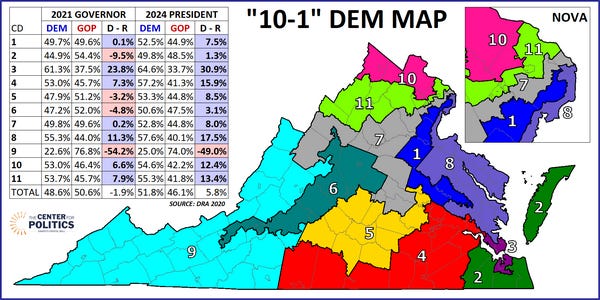
This map spreads out the state’s Democratic vote in such a way that 8 of the 11 districts would have voted to the left of the state for president in 2024. While it is not pictured here, Spanberger would have carried all 10 of the targeted Democratic districts by at least 9 points, with VA-2 (discussed momentarily) as the only one that did not give her a double-digit margin. Matching Spanberger is likely more aspirational than realistic for Democratic House candidates even in 2026, although matching or exceeding Harris is realistic.
If this map goes into effect, there would only be one sure-fire, Safe Republican district: western Virginia’s VA-9, currently held by Rep. Morgan Griffith (R). While Griffith would have an easy path in a general election, we wonder if Rep. Ben Cline (R, VA-6) could also try to run in the primary here: His home base of Botetourt County would also be in VA-9.
The other option for Cline would be to run in the new version of VA-6, a battleground district with a small Democratic lean (Harris won it by 3 points). This district stitches together Democratic enclaves and college towns like Roanoke, Charlottesville, Harrisonburg, and Blacksburg while also covering more Republican rural turf (as well as the very Republican Liberty University in Lynchburg). Former Rep. Tom Perriello (D, VA-5), who won a single term in 2008 and then lost in 2010 in competitive races, would be running here, although he could face primary opposition from a couple of Roanoke-based candidates, author Beth Macy and state Del. Sam Rasoul. This configuration actually puts Spanberger in somewhat of an awkward position, as she previously endorsed both Perriello and Macy for Congress. The 2021 and 2024 numbers for the proposed VA-6 are almost identical to the current VA-7, shown in Map 1. We currently have VA-7 rated as Likely Democratic, although as an open seat without an incumbent, we probably would rate the new 6th District as more competitive than that.
In the southeastern corner of the state, Rep. Jen Kiggans (R, VA-2) catches a break on this proposal—in fact, at first glance, her very marginal Virginia Beach-centered seat looks almost unchanged. While her district would flip from voting for Trump by a few tenths of a percentage point to voting for Harris by a little over a point, VA-2 would remain what it’s been in recent years: a classic swing seat. While Kiggans faces a well-credentialed opponent—former Rep. Elaine Luria (D), who held this district before losing to Kiggans in 2022—we probably would still call this a Toss-up, which is how we have VA-2 rated under the existing map. Under the proposed lines, Republicans would have won the new district’s House popular vote by about 2 points in both 2022 and 2024, although 2026’s (likely) bluer environment could be enough for Luria to win the seat back.
Certainly VA-2, and quite possibly VA-6, would also be targets for Republicans in 2028 or 2030 under this map, even if they lost both in 2026.
Beyond the deeply Republican VA-9 and the swingy VA-2 and VA-6, every other district in the state would have voted for Kamala Harris by at least 7.5 points or more in 2024. To do this, Democrats effectively “baconmandered” Northern Virginia, meaning that they cut up the heavily Democratic region’s core into narrow strips emanating out to much of the rest of the state. The wildest-looking district coming out of Northern Virginia is a re-imagined VA-7 that extends both to the West Virginia border and to the outskirts of the Richmond area. Another bacon strip, VA-8, contains both Ronald Reagan Washington National Airport and, as best we can tell, part of the Newport News/Williamsburg International Airport. That district appears to include the homebases of both Reps. Don Beyer (D, VA-8) and the aforementioned Wittman. The latter has been a relatively strong electoral performer, although Youngkin lost the proposed 8th by 11 points—so any Republican would have a tough time in the seat.
The five districts that contain pieces of Northern Virginia—VA-1, VA-7, VA-8, VA-10, and VA-11—would all be Safe Democratic in the context of 2026. We could see VA-8 being Likely Democratic if Wittman opted to run there, but it would still be a very uphill climb for him. By partisanship, Districts 1 and 7 are the most marginal of this lot, although as Map 2 shows, even Youngkin lost them, if by a few tenths of a point. We’d bet that those tight margins aren’t coincidental: mappers probably drew the plan reasoning that any seat Youngkin lost would also vote against Republicans in most circumstances.
The new VA-5 gives Henrico County Commonwealth’s Attorney Shannon Taylor (D) an obvious place to run. Taylor, who came within a couple of points of beating now-Attorney General Jay Jones (D) in last year’s statewide primary, is currently challenging Wittman in VA-1. Though this district, visually, takes in much of Southside Virginia, it could be thought of as the “suburban Richmond” seat. Parts of Chesterfield and Henrico counties, along with about 30 mostly white liberal precincts in Richmond proper, account for close to 80% of the district’s population. We have previously noted how the Richmond area was a bright spot for Harris in 2024 (and Democrats more generally in recent years). This proposed VA-5 actually gave Harris a very slightly larger margin in 2024 than it did Biden in 2020 (8.5 points instead of 8.2). This would be at least Likely Democratic for 2026.
Finally, Reps. Jennifer McClellan (D, VA-4) and Bobby Scott (D, VA-3) retain Safe Democratic districts anchored in Richmond and the Hampton Roads area, respectively. On paper, it would be easy to take Democratic voters out of VA-3 and put them into VA-2 to make the latter more Democratic without meaningfully changing the partisan makeup of VA-3. However, there may have been a reluctance by Democrats to meaningfully reduce the Black voter share in VA-3 because of Section Two of the Voting Rights Act. The U.S. Supreme Court could dramatically alter how Section Two and racial redistricting is understood in a ruling expected later this year, but that ruling obviously was not issued in time to impact this proposal. It also might be possible that McClellan was more willing to take in new voters. The current VA-4 had a 44%-42% Black plurality in 2020 but would switch to a 47%-42% white plurality under the proposed map. Meanwhile, the existing VA-3 had a 48%-39% Black plurality, which dipped slightly to 46%-41%.
As is often the case with partisan gerrymanders, which go through a drafting process where multiple stakeholders are involved, the product is not as “efficient” as what those of us who stare at maps all day could draw. The western border of McClellan’s district shows an example. While mappers took her further into Southside, her district stops short of Martinsville, a Black-plurality locality that remains in the map’s sole Trump-won seat. Moving Martinsville into VA-4 while giving parts of ruby red Pittsylvania County to VA-9 could increase Harris’s margin in the former by 2 percentage points.
In any case, the bottom line on this proposal is that Democrats should win at least 8 of its seats in 2026, and quite possibly 10. Last year, all three statewide Democrats carried 10 seats on the proposed map, even as they each won by varying margins. But Democrats could struggle to hold all of those seats in a less favorable political environment.