

Overall ratings summary:
HOUSE: 213 at least Leans D, 202 at least Leans R, 20 Toss-ups. See ratings.
SENATE: 48 at least Leans D, 47 at least Leans R, 5 Toss-ups. See ratings.
GOVERNORS: 24 at least Leans D, 22 at least Leans R, 4 Toss-ups. See ratings.
KEY POINTS FROM THIS ARTICLE
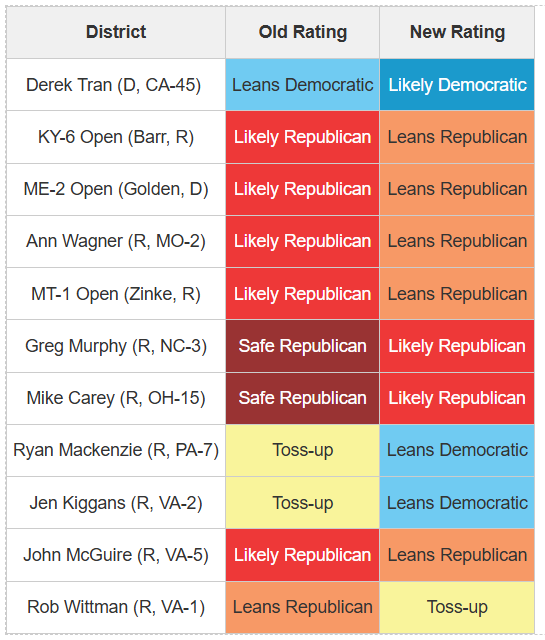
— A lousy month of polling for Republicans as well as individual developments in certain races prompts us to continue to move House races into better categories for Democrats.
— In our home state of Virginia, we are moving three GOP-held seats each a notch towards Democrats, which, notably, makes swing-seat Rep. Jen Kiggans (R, VA-2) a slight underdog.
— In Pennsylvania, Rep. Ryan Mackenzie (R, PA-7) holds another classic swing seat; we are also moving his race from Toss-up to Leans Democratic.
— Although we’d be shocked if he lost, we are making Gov. Phil Scott (R-VT) a less secure favorite after two pollsters showed his vote share stuck in the mid-40s. We are also making Gov. Jim Pillen’s (R-NE) race a little more competitive.
Table 1: Crystal Ball gubernatorial rating changes

Table 2: Crystal Ball House rating changes
GOP’s rough post-Labor Day stretch prompts more rating changes
As September winds down, we are closing out what has been a tough month for Republicans. By most measures, Democrats have expanded their lead on the House generic ballot and are in serious contention to flip the Senate. And—getting more to the Green Day pun that we led with—many pollsters have consistently shown that Democrats are just more enthused than Republicans. An Emerson College poll from last week found that 78% of Democrats are excited to vote in November while 66% of Republicans are.
To keep pace with the evolving environment, we have been regularly moving ratings toward Democrats over the past couple of weeks. This week’s changes continue that trend, even as Republicans retain the advantage in many of the races we will discuss. We are also making a pair of gubernatorial rating changes in Nebraska and Vermont; while Republicans are still favorites in both, each race gets more competitive.
— Late last week, the New York Times and Siena University published a survey of three states that are hosting both Senate and gubernatorial races: Maine, Michigan, and New Hampshire. These polls were broadly supportive of our ratings in the three Senate races in these states: The polls showed Democrats with mid-single-digit leads in Michigan and New Hampshire—two states they are defending—while Sen. Susan Collins (R-ME) was up by a slightly smaller 49%-46% in her race, even as NYT analyst Nate Cohn acknowledged his poll made for something of a pro-Collins outlier (Democrat Troy Jackson has generally led other recent polling). In any case, and prior to that poll release, the Crystal Ball moved Michigan’s Senate race from Toss-up into the Leans Democratic category, where it joined New Hampshire. We have had Maine rated as a Toss-up for the entire calendar year, and it still seems stuck there.
How one feels about Maine may play an outsized role in how one feels about the Senate. If one was confident in Jackson winning, the path to a Democratic Senate majority would be clearer, because Democrats winning at least two double-digit Trump states is now very much on the table: While we still call them Toss-ups, Democratic odds in Alaska and Ohio are probably now a little north of 50-50. But if one thinks Collins is favored, Democrats would then need not just Alaska and Ohio, but also another red state, most likely Iowa or Texas. For us, Senate control is positioned right on the edge of the butter knife. While recent polling has showed Democrats leading in states like Ohio and Texas, they are, at the end of the day, clearly red states.
The New York Times and Siena also released a poll of Pennsylvania, where they partnered with the Philadelphia Inquirer. Not surprisingly, the poll found Gov. Josh Shapiro (D-PA) as a prohibitive favorite for reelection, as he led state Treasurer Stacy Garrity (R) by 20 points. It may say something about the political environment of 2026 that Garrity, a credible recruit, could lose by a larger margin than Shapiro’s last opponent, state Sen. Doug Mastriano (R), a far-right candidate who ran an unserious race.
The NYT/Siena/Inquirer poll also gave Democrats a 53%-44% lead on the generic House ballot in the Keystone State. In 2024, Republicans won the state’s House popular vote by a 51%-49% margin (although PA-3, which was Kamala Harris’s best district in the country, was uncontested, so the actual total looks slightly better for Democrats than what it “should” be); with that, Republicans held the eight seats that they were defending and picked off two Democratic-held seats, PA-7 and PA-8, both in the eastern part of the state. Of course, these districts will have a certain race-by-race dynamic too, but if Democrats end up with anything close to a 9-point overall advantage in Pennsylvania, it would be very hard to see Republicans holding all their marginal seats. At minimum, we think that, in such a scenario, first-term Rep. Ryan Mackenzie (R, PA-7) would be hard-pressed to hold on against his Democratic challenger, Bob Brooks. In 2024, Trump carried this classic swing seat 51%-48%; in that election, Republicans ran especially well in the heavily Latino precincts of Allentown—a group where we’d expect some reversion this year given broader Republican erosion among Latinos. As of last quarter, Mackenzie had more cash-on-hand, although Brooks, who has campaigned with Shapiro, raised more during the quarter. Local pollster Franklin & Marshall College found Brooks up 45%-40% last week. We are moving PA-7 from Toss-up to Leans Democratic.
— Over the past couple of weeks, we have found ourselves citing Virginia as something of a proxy for how the larger battle for the House might play out, particularly because the Old Dominion has an early poll closing, so election-watchers will be mining the state for clues early on Election Night. As it is, all 6 of the state’s Democratic-held House seats are fairly secure—we rate the most marginal of those, VA-7, as Likely Democratic, while the 5 others are all Safe Democratic. Democrats are seriously contesting a trio of Republican seats, with each seat representing a different tier of the “wave watch.”
In the Virginia Beach area, Rep. Jen Kiggans (R, VA-2) holds what was one of the most evenly divided districts in the 2024 presidential election, as her seat voted for Trump by about 1,100 votes out of nearly 415,000 cast. Last year, VA-2 backed 2 of the 3 winning statewide Democrats, and its sole loser, now-Attorney General Jay Jones (D), lost it by a percentage point (his opponent, Republican Jason Miyares, is also from the district). Since the 2008 elections, VA-2 has also reliably sent a member of the majority party to the House. With that in mind, we are moving VA-2 from Toss-up to Leans Democratic, as we ultimately think Kiggans will have a hard time fighting against the wave against former Rep. Elaine Luria (D), who Kiggans unseated in 2022. If Democrats go on to flip this seat, they are likely at least on track for the type of slim majority that they held after the 2020 elections (a Republican hold would probably be part of a broader overperformance).
Going west on I-64, VA-1 has a lot in common with the types of districts that flipped in 2018: though Trump carried it by 5 points in 2024 and it easily reelected a GOP incumbent, Kamala Harris outperformed Joe Biden in the district, meaning that it is trending Democratic. We’d consider Rep. Rob Wittman (R, VA-1) to be one of Republicans’ stronger incumbents, and a recent internal poll from his opponent, Henrico County Commonwealth’s Attorney Shannon Taylor (D), still gave him a 1-point lead, so Wittman probably is still leading, but perhaps not by that much. We are moving this district from Leans Republican to Toss-up. If Taylor ends up beating Wittman, it would certainly suggest a Democratic majority larger than the narrow ones both sides have held in recent years. The district has attracted a considerable amount of Democratic outside spending so far. This move is similar to another we made recently in a traditionally Republican but competitive district, the southwest Michigan seat held by Rep. Bill Huizenga (R, MI-4). Wittman and Huizenga may very well survive but both are being pushed to a degree that they were not in their previous races.
Finally, if Democrats flip VA-5, which includes Charlottesville and Southside Virginia, it would be consistent with a 2006-style blue wave. In fact, at Trump +12, the district’s 2024 presidential partisanship is comparable to that of many of the key Senate Toss-up states. Former Rep. Tom Perriello (D) has outraised current Rep. John McGuire (R) on a candidate-to-candidate basis, and the former has also gotten more outside help in what appears to be an intensifying race. The first signs from early voting appear strong for Democrats in this district, per shrewd analysts Chaz Nuttycombe and Zachary Donnini. We are moving VA-5 from Likely Republican to Leans Republican.
— Elsewhere, we are also moving 4 other districts that backed Trump in 2024 from Likely Republican down to Leans Republican.
In Kentucky’s Lexington-centered 6th District, former state Sen. Ralph Alvarado (R)—who was also then-Gov. Matt Bevin’s (R) running mate during an unsuccessful 2019 reelection campaign—made news for removing references to Trump from his website, even as he campaigned with Trump’s support during the May primary. Considering that the district backed Trump by 15 points in 2024, it would not strike us as the type of place where a Republican would normally want to keep Trump at arm’s length. But it is often more competitive down the ballot, and a slightly less red version of this district was a near-miss for Democrats in 2018. Meanwhile, Gov. Andy Beshear (D) has gotten involved on behalf of Zach Dembo, a former prosecutor who is the Democratic nominee.
In July, we moved Maine’s open 2nd District from Leans Republican to Likely Republican. Today, we are reversing that change, as it’s possible we may have been too bearish on Democrats’ chances to hold the seat. Though several Democratic internal polls showed an essentially tied race over the summer, a University of New Hampshire poll from last week found state Auditor Matt Dunlap (D) leading former Gov. Paul LePage (R) by a 51%-45% vote. Given the terrain of the district, the UNH poll may very well be an outlier, although UNH did accurately predict that now-outgoing Rep. Jared Golden (D) would hold on by 1 point in 2024.
Democrats must have breathed a collective sigh of relief on Friday when the Supreme Court—for what shold be the final time—made clear that the 2022 map, which preserved MO-5 as one of two blue seats on the map, should be used for this year’s elections. This effectively blocks a 7-1 GOP gerrymander, at least for 2026. If Rep. Emanuel Cleaver (D, MO-5) was the major beneficiary of the high court’s intervention by being restored to a Safe Democratic seat, Rep. Ann Wagner (R, MO-2) was also hurt to some extent. Under the GOP’s proposed new map, Wagner would have gotten a Trump +11 seat as her existing district became more rural. Instead, she keeps a blue-trending Trump +8 seat—the St. Louis County part of MO-2, which makes up a majority of the district, actually swung to Kamala Harris in 2024. A recent poll from GOP pollster Remington Research put Wagner up only a nominal 43%-42% over Democratic nominee Fred Wellman, and this one merits watching as a late addition to the more competitive group of districts.
Finally, an independent poll of Montana’s 1st District by NonStop Local and the American Pulse showed Democrat Sam Forstag and Republican Aaron Flint both taking a little over 45% of the vote. The race has recently seen an uptick in outside spending. Though now-outgoing Rep. Ryan Zinke (R) was an underperformer and likely did his party a favor by stepping aside, this district has seen relatively close races since it was reestablished after the 2020 census: Zinke won the seat by 3 points in 2022 and by less than 8 points in 2024. As with the aforementioned Alvarado scrubbing mentions of Trump, Forstag, the Democrat, similarly removed references to several national progressive leaders from his site recently.
— NC-3 and OH-15 both move from Safe Republican to Likely Republican. In NC-3, former state Rep. Raymond Smith (D) has attracted enough outside support to put some pressure on Rep. Greg Murphy (R), including more than $300,000 in outside spending against Murphy. Remember, while Republicans passed a refreshed gerrymander last year aimed at weakening Rep. Don Davis (D, NC-1), Murphy also got less safe as many of the coastal Republican voters in his district were given to Davis. Though the new 3rd includes all of Pitt County (Greenville), Onslow County (Jacksonville), which usually votes two-to-one Republican and casts about a quarter of the district’s votes, still makes the district tough for Democrats. The term “dummymander” gets thrown around a lot, and it can happen if a party does worse on a gerrymandered map than it would have if it had just left the map alone. If Democrats were to defend Davis and also defeat Murphy—a tall order, to be clear—the NC map would fit the definition, because only two districts in the state were changed, as Republicans weakened NC-3 to make NC-1 redder.
OH-15, which extends west from Columbus and backed Trump by 10 points, is also a district that has seen more outside spending than what one might expect, and the Democratic-aligned House Majority PAC released a poll yesterday with their nominee, Don Leonard, up 46%-45% on Rep. Mike Carey (R). As we always say, take the publicly-released internals with a grain of salt.
— In, perhaps, a move we could have made during our recap of the California primary, we are making Rep. Derek Tran (D, CA-45), who won his seat in one of 2024’s closest contests, a clearer favorite. Tran took 54% in the June primary, and the race does not appear to be part of the battlefield this year. The gerrymander that Gov. Gavin Newsom (D) pushed for last year shored up several Democrats in marginal districts—in the case of CA-45, Tran got more of a cushion as Harris’s margin in his district grew from 49%-48% to 51%-47%.
— Finally, we have a couple of gubernatorial rating changes. The first such case is in a contest where we have, admittedly, received mixed signals. Last week, arguably the biggest “shock poll” that surfaced amidst a stream of fairly good results for Democrats came in Vermont. The University of New Hampshire found five-term Gov. Phil Scott (R-VT) trailing his little-known Democratic opponent, Amanda Janoo, by a 49%-43% vote. Over the summer, UNH also released a pair of polls where Scott was leading in potential matchups with Janoo (who was not yet officially the nominee), although his vote share was similarly in the mid-40s. Of course, while it wouldn’t be too difficult to understand why Scott’s showing this year could be weaker than some of his past performances, it was a surprise to see him actually behind in a public poll—as far as we can tell, he has never trailed in a public poll over his previous 4 reelection campaigns, despite the deep blue lean of his state.
After discussing the race with some sources, though, we remain skeptical that Scott is truly vulnerable. One of our contacts pointed out that much of Scott’s advertising and efforts this year have been dedicated toward helping Republicans maintain the legislative gains that they made in 2024—in other words, if the race were really close, it might be easier to see Republicans pivoting to go negative against Janoo. Outside groups have also largely stayed out of the race. So, considering that intel, we were inclined to just keep the race’s Safe Republican rating as-is for this update.
However, Vermont Public released an independent poll yesterday where Scott was also in the mid-40s, though he was leading Janoo by a 44%-34% vote. We are moving the race down to Likely Republican because a second pollster has found a relatively close race. We would also note that State Navigate is raising money to crowdfund a poll of the race, so perhaps we’ll soon get another data point in Vermont.
One of the big surprises of 2014 was that Scott’s predecessor, then-Gov. Peter Shumlin (D), was held under a majority in his bid for a third, two-year term. He was eventually reelected by the Democratic-controlled state legislature, which decides the gubernatorial race in the event no one wins a majority of the vote. We wanted to at least flag the possibility that Scott, an excellent performer in what is otherwise one of the bluest states in the country, could face more of a test this year than in the past.
One last change we’re making today is in Nebraska. While Gov. Jim Pillen (R) remains favored over former state Sen. Lynne Walz (D) in polls, this race is a little more intriguing than usual because of a third-party candidate: former Republican state Sen. Brett Lindstrom is running under the America First Party. Though Lindstrom was a more moderate Republican, we wonder if his new party label could naturally pull Trumpy voters from Pillen. There is also a “weed party” candidate in the race, Rick Beard. A Democratic poll out this morning showed the major-party candidates tied at 40% apiece while the two minor-party candidates combined for 13%. Another shrewd analyst, Ethan Chen, pointed out that Pillen was a rare Republican that the state Farm Bureau has not endorsed. We are moving the race from Safe Republican to Likely Republican.